
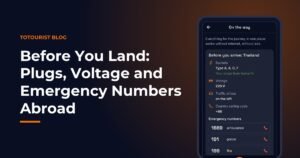




You land, switch off flight mode, and your phone is on 9%. Your charger does not fit the socket, you do not know whether you need a converter, and you have no idea which number to call if something goes wrong. A five-minute arrival checklist – plugs, voltage, emergency numbers and the side of the road – done before you fly saves you from all of that.
1. Plug type: will your charger fit?
There are about 15 common household plug types in the world, labelled with the letters A to O. Neighbouring countries often share a type, but not always: the United Kingdom and Ireland use Type G with three rectangular pins, while most of continental Europe uses Types C, E and F with two round pins.
What to do before you go:
- Look up the plug types used at your destination and compare them with the plugs on your own chargers.
- If they differ, pack a plug adapter. A universal travel adapter covers most countries; one adapter plus a small multi-socket extension lets you charge several devices from one wall socket.
- Hotels sometimes lend adapters, but do not count on it when you arrive late at night.
2. Voltage: adapter or converter?
Mains electricity comes in two big families: around 100–127 V, used mainly in North America and Japan, and around 220–240 V, used in most of Europe, Africa, Asia and South America.
This matters because a plug adapter only changes the shape of the plug – it does not change the voltage. Check the small print on each charger or power brick:
- “INPUT: 100–240V” – the device works everywhere; a simple plug adapter is enough. Most phone and laptop chargers are like this.
- A single voltage, e.g. “120V” or “230V” – the device is made for one family only. Plugging a 120 V device into a 230 V socket can destroy it. You need a voltage converter, or leave it at home. Hair dryers, straighteners and electric shavers are the usual suspects.
3. Emergency numbers: save them before you need them
In an emergency nobody wants to search the internet for the right number – and you may not have mobile data at that moment. Write the local numbers into your phone before you leave. A few examples:
- European Union: 112. It works everywhere in the EU, from fixed and mobile phones, free of charge, and in many countries the operators also answer in English or French. 112 is also used in some countries outside the EU, such as Switzerland and South Africa.
- United Kingdom: 999 or 112.
- United States and Canada: 911.
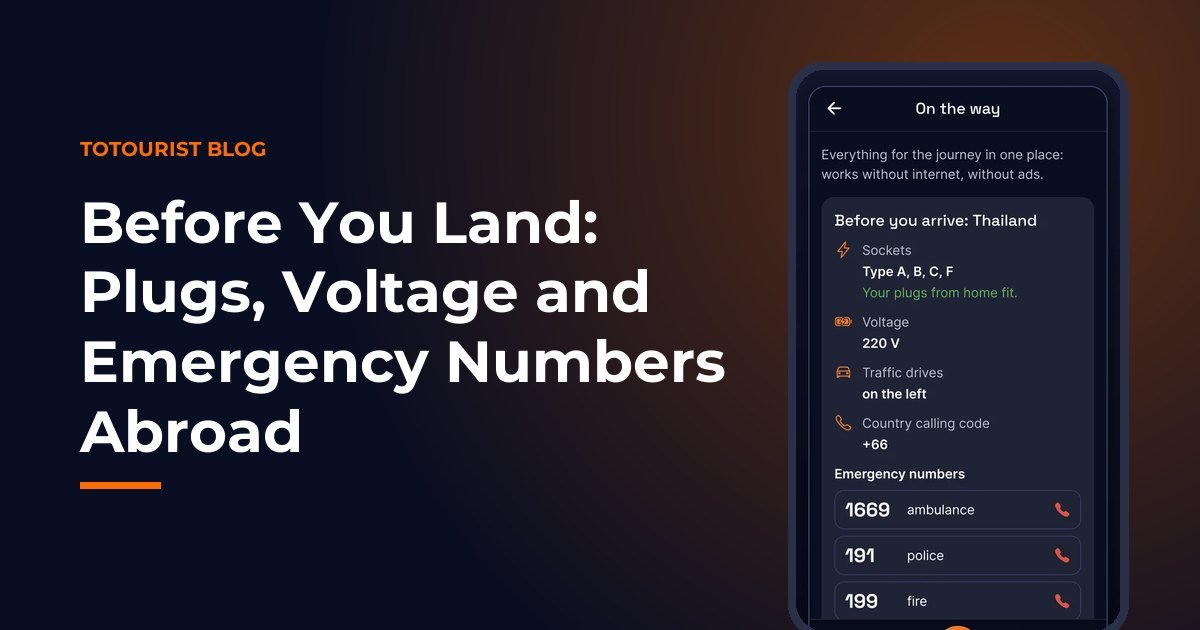
- Thailand: 191 for police, 1669 for medical emergencies, and 1155 for the Tourist Police.
Many countries have separate numbers for police, ambulance and fire, so check all three for your destination. It is also worth saving the address and phone number of your country’s embassy or consulate.
4. Which side of the road do they drive on?
Even if you are not renting a car, this decides which way you look before crossing the street. Traffic drives on the left in the United Kingdom, Ireland, Malta, Cyprus, Japan, India, Thailand and Australia, among others. If you are used to right-hand traffic, look both ways twice for the first few days – and if you do drive, take extra care at roundabouts and when turning.
5. The country calling code
Local phone numbers on booking confirmations and restaurant websites are often written without the country code. To call them from your own SIM, add the destination’s code – for example +66 for Thailand or +34 for Spain. Saving your accommodation’s number in this full format before you fly avoids confusion at the airport.
Your arrival checklist
- Plug type at the destination – adapter packed if needed.
- Voltage – every charger checked for “100–240V”.
- Emergency numbers for police, ambulance and fire saved in your phone.
- Driving side noted, especially if you rent a car.
- Accommodation phone number saved with the country code.
Have it all on your phone, offline
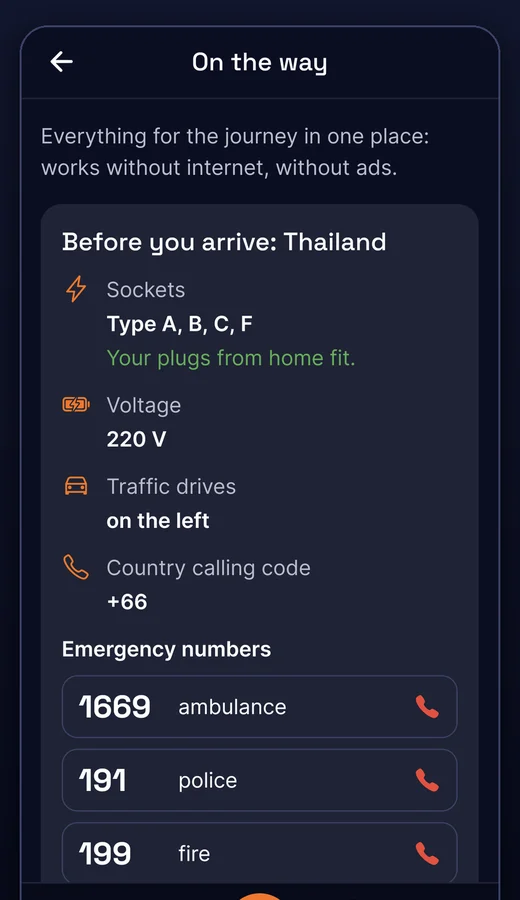
The On the way screen of the ToTourist app shows exactly this for 196 countries: the plug types, whether your plugs from home fit, the voltage, which side traffic drives on, the calling code and the emergency numbers – which you can call with one tap. It downloads by itself when you open your trip, so you can read it on the plane and abroad without internet.